


2–10A for LEDs: Trailer Light Fuse Size for US DIYers & Fleet Techs
Size the fuse to protect the wire, not just the bulbs. Pick a fuse rated just above your circuit’s continuous current draw but never above the wire’s ampacity. For most setups, that means a 2 to 10 amp fuse for LED running and marker lights, 10 to 20 amp fuses for combined incandescent tail/turn circuits, and higher ratings for multi-lamp harnesses or trailer battery charge lines. Mount the fuse close to the power source, always.
TL;DR:
- Use a fuse rated just above the circuit’s continuous load, typically 2 to 10 amps for LED lights and 10 to 20 amps for incandescent setups, without exceeding wire capacity.
- Verify fuse placement is close to the power source to ensure proper wire protection and check ground connections regularly for corrosion or looseness.
- When upgrading to larger loads or additional circuits, increase wire gauge rather than fuse size to maintain safety margins.
- Troubleshoot repeatedly blowing fuses by isolating the trailer from the vehicle, testing wiring and connectors for shorts, and inspecting bulbs for faults.
- Consult specific vehicle manuals and wiring guides to determine exact fuse ratings and locations, particularly for 7-pin connectors or complex trailer systems.
Table of Contents
- What Are Typical Trailer Light Fuse Sizes?
- How to Calculate the Correct Fuse Size
- Where Should the Trailer Light Fuse Go?
- Why Does the Trailer Light Fuse Keep Blowing?
- Safety Rules for Trailer Light Fuses and Wiring
- Does a 4-Pin or 7-Pin Connector Change Fuse Sizing?
- Do Utility Trailers and Travel Trailers Need Different Fuse Ratings?
- Publisher Perspective: Why Fuse Sizing and Component Quality Go Together
- Light Kits and Wiring Built for Correct Fuse Sizing
- Where to Verify Exact Ampacity and OEM Fuse Numbers
- Sources
- FAQ
What Are Typical Trailer Light Fuse Sizes?
Most trailer lighting problems trace back to a mismatch between the fuse rating and what’s actually running through the wire. The right number depends heavily on whether you’re running LEDs or old-style incandescent bulbs.
LED running and marker lights draw very little power. A single LED marker lamp might pull under half an amp, and even a loaded LED light bar rarely exceeds a couple of amps. That’s why recommended fuse ranges for LED lighting circuits commonly fall between 2 and 10 amps, depending on how many lamps share the circuit.
Incandescent bulbs are a different story. A standard 1157 or 2057 dual-filament bulb can draw over 2 amps on its own when both filaments fire (brake plus running light). Multiply that across a full trailer’s worth of stop, turn, and tail lamps, and combined-circuit draw often lands in the 5 to 15 amp range per side.
Here’s how the fuse formats typically break down:
- ATO/ATC blade fuses: the standard size, used on most trailer and truck wiring harnesses.
- Mini blade fuses: smaller footprint for densely packed fuse panels, same amperage range.
- Maxi blade fuses: built for higher-current circuits like winches or battery charge lines, not typical lighting loads.
How to Calculate the Correct Fuse Size
You don’t need an electrical engineering degree, just four steps and a calculator.
- List every light on the circuit and its wattage. Check the bulb or LED spec sheet, or use manufacturer wattage ratings if you’re not sure.
- Convert watts to amps. Divide wattage by 12 (since trailer systems run on 12 volts). A 25 watt incandescent bulb draws about 2.1 amps.
- Add up the amps for everything on that circuit. This is your continuous load.
- Match wire gauge to fuse rating. Find your wire’s ampacity by AWG size, then pick a fuse that sits at or below that number, roughly 10 to 25% above your calculated continuous load.
Here’s a worked example. Say you’re wiring a full LED trailer light kit: two tail/stop/turn combo lamps at roughly 1.5 amps each under braking, plus two marker lights at 0.3 amps each. That’s about 3.6 amps total. A 5 amp fuse gives you margin without oversizing. Compare that to an incandescent setup with four 2057 bulbs on one side pulling 2.1 amps apiece under braking, roughly 8.4 amps combined, which is why so many stock harnesses ship with 15 amp fuses on that circuit.
Pro Tip: If you’re unsure whether your load might grow (adding auxiliary lights, a winch, or interior lighting later), upsize the wire gauge, not the fuse. A fatter wire gives you headroom; a bigger fuse just removes the protection the wire needs.
Where Should the Trailer Light Fuse Go?
Fuse placement matters as much as fuse rating. A fuse only protects the wire between itself and the load, so anything upstream of the fuse holder is unprotected.
- Install the fuse holder as close to the battery or power source as physically practical, ideally within a few inches.
- If you’re running a relay or isolation harness for auxiliary lighting, protect the feed wire into the relay right at the source. The relay’s coil trigger wire often needs its own small fuse too, separate from the main lighting circuit.
- Check ground quality regularly. A weak ground can mimic a blown fuse or cause flickering that looks like a wiring fault.
- Inspect pin condition on 4-pin and 7-pin connectors each season. Corrosion here is one of the most common causes of intermittent lighting failure.
- Route wiring away from moving parts, sharp edges, and exhaust heat to prevent chafing that leads to shorts down the road.
Vehicle manufacturers sometimes locate trailer tow fuses under the dash and sometimes under the hood, which affects how fast you can troubleshoot roadside. Ford’s fuse documentation, for example, lists dedicated fuses for trailer tow park lamps, stop lamps, and backup lamps with specific amperage ratings, which is why checking your owner’s manual first saves a lot of guesswork.
Why Does the Trailer Light Fuse Keep Blowing?
A fuse that blows repeatedly is telling you something real is wrong. It’s rarely the fuse itself.
- Isolate the trailer from the tow vehicle and check whether the fuse still blows with the harness disconnected. If it does, the fault is on the vehicle side.
- Test for continuity and voltage drop with a multimeter before assuming a component is bad.
- Inspect bulbs and sockets for a short between the filament and housing, a common failure point on cheap incandescent bulbs.
- Check connector pins and grounds on both the 4-pin or 7-pin plug and the trailer-side harness. Corrosion here causes resistance that can spike current draw.
- Isolate harness segments one at a time to narrow down where a short to chassis or ground is occurring.
Community troubleshooting threads consistently point to the same culprits: a short to ground, corroded pins, or a pinched wire rubbing against the frame. One widely referenced Ford forum thread on trailer tow fuses walks through exactly this kind of isolation testing to trace an intermittent running-light fault. If you’ve gone through every step and the fuse still blows immediately, it’s time to replace suspect wiring rather than keep swapping fuses. Real-world reports on failed trailer lighting circuits show connector corrosion and blown vehicle-side fuses cause more failures than bad lamps ever do.
Safety Rules for Trailer Light Fuses and Wiring
The fuse’s whole job is to protect the wire, never forget that. If a fuse keeps blowing and your instinct is to jump to a higher amperage “just to stop the nuisance,” stop. An undersized wire will overheat and potentially start a fire long before an oversized fuse ever trips.
- Inspect wiring seasonally for discoloration, melted insulation, or heat damage near connectors and fuse holders.
- Check terminals for looseness, especially at the trailer plug where vibration works connections loose over time.
- Carry a set of labeled spare fuses matched to your actual circuit ratings, plus a fuse puller and basic test light.
- Keep a simple wiring diagram or label your circuits so future troubleshooting doesn’t start from zero.
Pro Tip: Tape a small card inside your tow vehicle’s fuse box lid listing which fuse feeds the trailer lights and its amp rating. It saves real time at a dark rest stop.
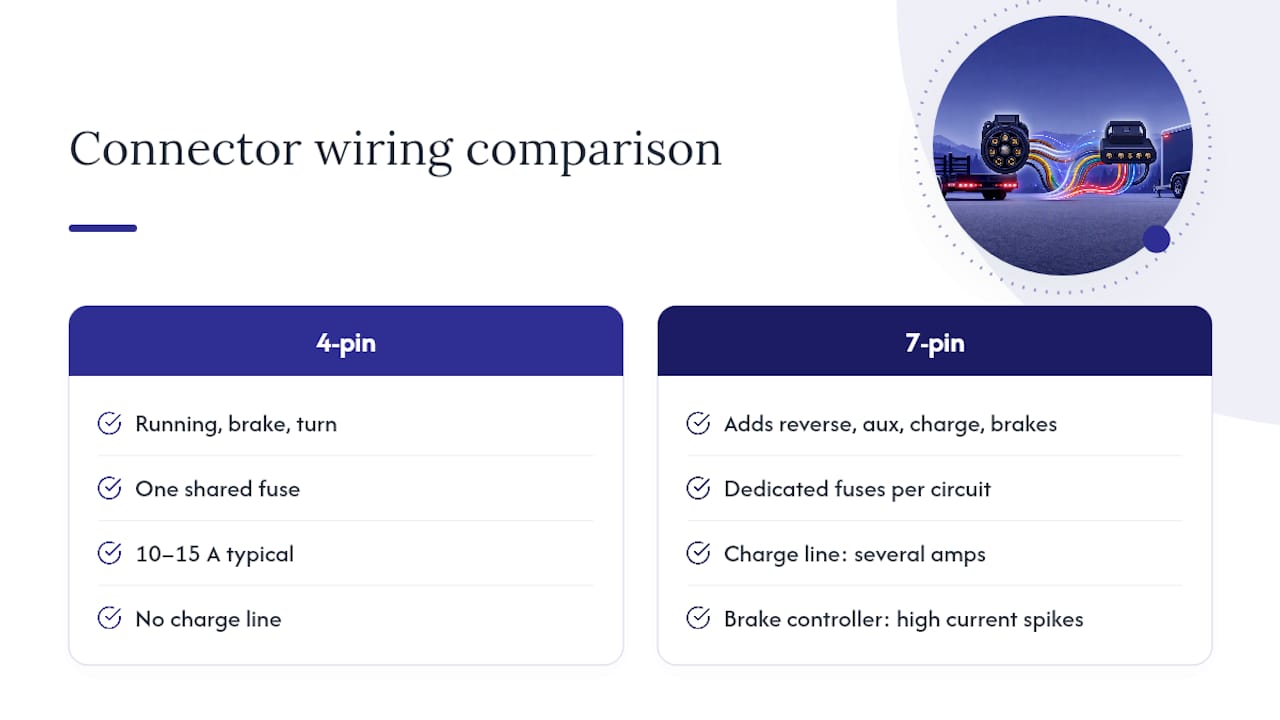
Does a 4-Pin or 7-Pin Connector Change Fuse Sizing?
The connector type itself doesn’t change how amperage math works, but it does change how many circuits share a fuse and how much total load that fuse needs to handle.
A standard 4-pin flat connector handles running lights, brake lights, and turn signals on one shared ground, typically pulling low combined current, especially with LED lamps. These circuits often run fine on a 10 to 15 amp fuse on the vehicle side, since the load stays modest even with all lights active simultaneously.
A 7-pin connector adds circuits for reverse lights, a charge line to the trailer’s battery, an auxiliary power feed, and sometimes electric brakes. Each of those additional circuits either needs its own fuse or a higher-rated shared fuse that accounts for the combined draw. The charge line alone can pull several amps continuously to maintain a trailer battery, and electric brake controllers can spike current well beyond what a basic lighting circuit ever sees.
This is why 7-pin setups on travel trailers and larger utility trailers often use a fuse block with multiple individual fuses rather than one fuse for everything. It isolates a fault. A short in the brake circuit won’t take down your running lights if each circuit has its own dedicated fuse sized to its own load. If you’re upgrading from a 4-pin to a 7-pin setup, don’t assume your old fuse rating still applies. Recalculate based on every new circuit you’ve added, including whether you’re now running electric brakes or a battery charge line off that connector.
Do Utility Trailers and Travel Trailers Need Different Fuse Ratings?
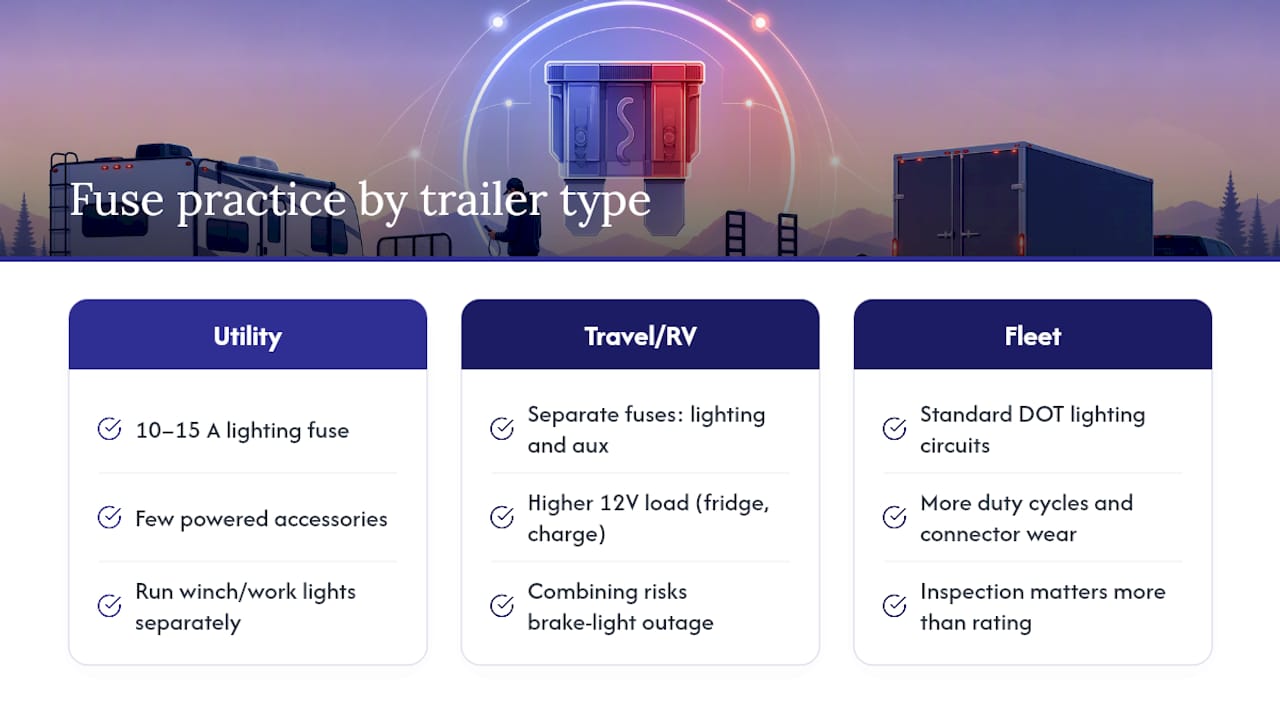
Vehicle and trailer type changes the calculation more than most people expect, mainly because the number of powered accessories scales up fast.
A basic utility trailer or boat trailer usually runs nothing but lights: running, brake, turn, and maybe backup. Total continuous draw stays low, especially with LED lamps, so a single 10 to 15 amp fuse on the lighting circuit is typically sufficient. There’s little reason to size up unless you’re adding auxiliary work lights or a winch, and those should run on their own separate, appropriately sized fuse anyway.
Travel trailers, campers, and RVs carry a heavier electrical load: interior lighting, a battery charge line, sometimes a fridge or slide-out motor drawing off the 12 volt system through the tow connector. That’s why manufacturer wiring kits for campers and RVs often spec separate fuses for the lighting circuit and the battery charge or auxiliary circuit, rather than lumping everything onto one fuse. Combining a high-draw charge line with your lighting circuit on a single fuse means any accessory fault can knock out your brake lights, which is a real safety problem on the highway.
Fleet and commercial trailers split the difference. They typically stick to DOT-mandated lighting circuits without the extra battery or accessory draw of an RV, but they see far more duty cycles and connector wear, so fuse and connector inspection matters more than fuse rating itself.
Publisher Perspective: Why Fuse Sizing and Component Quality Go Together
Correct fuse sizing only works long term if the components behind it are built to hold up. Some LED kits are built to meet DOT FMVSS 108 standards with IP67 and IP68 waterproof ratings, because a housing that lets moisture in creates the corrosion and shorts that blow fuses in the first place.
Lower current draw from LED lighting doesn’t just save power, it shrinks your margin for error. A well-built LED kit pulling 3 amps instead of 8 gives you more breathing room between continuous load and fuse rating, which means fewer nuisance trips and fewer roadside surprises. That’s the real payoff of pairing correct fuse math with hardware that’s built not to fail in the first place. For fleet operators, that translates directly into fewer callbacks and less time spent chasing intermittent lighting faults.
— All
Light Kits and Wiring Built for Correct Fuse Sizing
Some companies sell DOT-compliant LED lighting and wiring that are engineered to draw less current and survive the road.
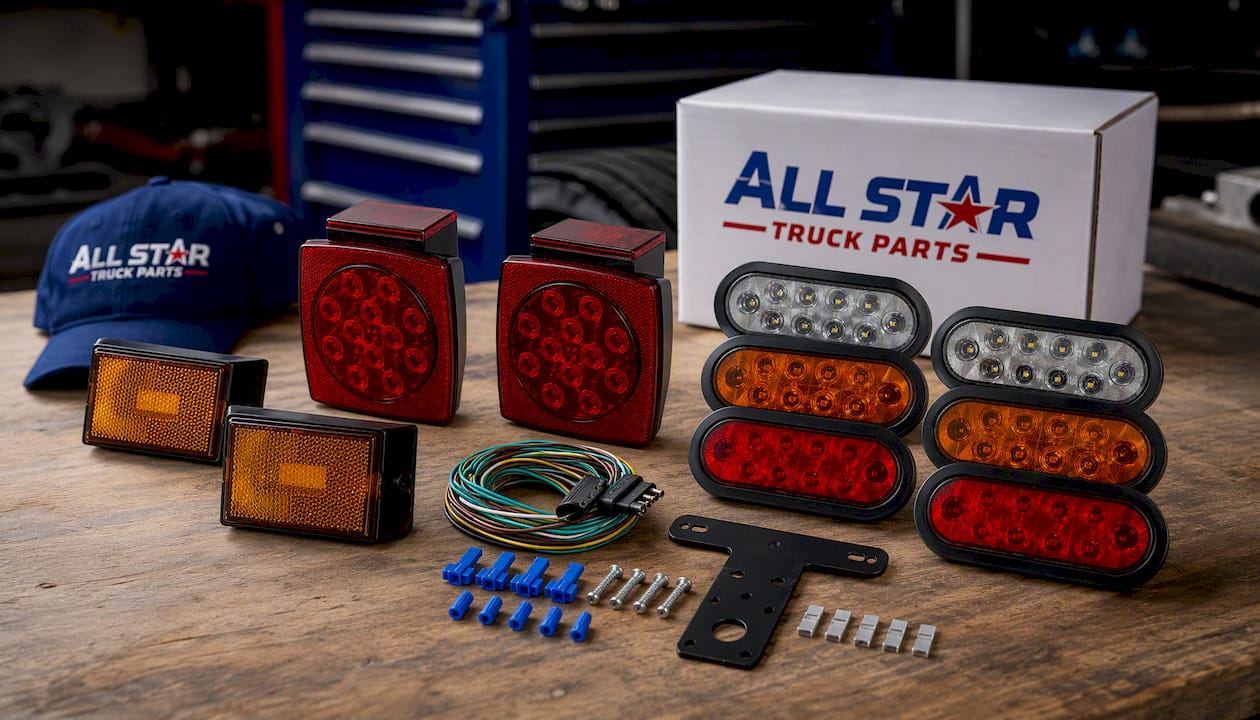
If you’re replacing incandescent lamps to simplify your fuse sizing, the 5x3 inch rectangle 42 LED trailer tail light kit is DOT FMVSS 108 certified with a submersible, sealed housing, good for tow trucks and wide trailers needing a combined stop/turn/tail/halo signal in one lamp. For a full plug-and-play rebuild, the 12V LED trailer light wiring kit covers brake, turn, tail, and license lighting for boats, campers, and RVs under 80 inches wide, with IP68 waterproofing built in. And for a lower-profile multi-function option, the 6-inch oval 10 LED stop turn tail light kit handles mid-turn, parking, and reverse signals with grommets and plugs included.
Every product page lists the wire gauge and recommended fuse rating for that specific kit, so check the specs before you wire it in. If you’re unsure which fuse pairs with your setup, reach out to support and they’ll walk through the math with you.
Where to Verify Exact Ampacity and OEM Fuse Numbers
For the hard numbers behind this guide, a few sources are worth bookmarking:
- Wire ampacity and fuse safety guidance for AWG-to-amperage tables and the fuse-versus-wire protection rule.
- Ford’s owner and service fuse documentation for exact vehicle-side trailer tow fuse locations and ratings.
- eTrailer’s harness Q&A for real product-level wire gauge and included fuse specs.
Vehicle manuals answer where your fuse box is; wiring guides answer what size wire it should protect.
Sources
- Best trailer light fuses & road safety guidance
- Ford owner/service fuse table and trailer tow fuse references
- Trailer running lights not working at plug on truck - iFixit answers
FAQ
Which Fuse Should I Use for Trailer Lights?
Match the fuse to your wire gauge and total continuous load, typically 2 to 10 amps for LED circuits and 10 to 20 amps for incandescent or combined circuits, always at or below the wire’s rated ampacity.
What Size Fuse Should I Use for a 12 Volt Circuit Like a Cigarette Lighter Outlet?
Standard 12 volt accessory outlets typically use a 10 to 15 amp fuse, but always check the specific accessory’s current draw and the wire gauge feeding that circuit before choosing.
How Many Amps Does a Trailer Light Use?
A single LED marker light draws well under 1 amp, while a full incandescent stop/turn/tail combo lamp can draw over 2 amps under braking, so total draw depends entirely on how many lamps share the circuit.
Are There Separate Fuses for Trailer Lights?
Yes, most vehicles have a dedicated fuse for trailer tow lighting separate from the vehicle’s own lights, and larger 7-pin setups often split lighting, battery charge, and brake circuits across multiple individual fuses.
Why Does My Trailer Light Fuse Keep Blowing?
The most common causes are a short to ground from chafed wiring, corroded connector pins, a faulty bulb socket, or a mismatched fuse installed above the wire’s safe ampacity.
Recommended
- Heavy Duty 3.29"x1.6" Surface-Mount 6 LED Trailer License Plate Lights
- 12V Waterproof Square LED Trailer Tail Light Kit Clear Lens Red Trailer Brake Stop Tail Turn Signal Running Lights License Kit for Camper Truck RV Boat Trailer Snowmobile Marine
- 12V LED Magnetic Towing Light Kit for Boat Trailer RV Truck -Magnetic
- DOT Compliant 16 LED Jeep style Universal Tail Brake Turn Stop Back up
