


Fix DOT Lighting Before Your Next Inspection: U.S. Fleet Checklist
Commercial vehicles must carry the lamp functions, quantities, colors, and mounting positions specified in 49 CFR §393.11 and FMVSS No. 108. That means the right count of headlamps, turn signals, tail lamps, and stop lamps, mounted within federal height and spacing ranges, showing the correct colors, and carrying visible DOT markings. Trailers 80 inches or wider need retroreflective conspicuity treatment too. Run a pre-trip lighting check before every haul and buy only DOT-marked replacement parts.
TL;DR:
- Trailer width over 80 inches requires retroreflective sheeting or reflex reflectors to enhance visibility at night, with proper placement to maximize safety.
- All lamps must be mounted on a permanent, rigid part of the vehicle at specified heights, measured from curb weight, to ensure proper visibility and regulation compliance.
- Replacement lamps must carry a visible DOT marking and meet FMVSS No. 108 standards, including proper color, function, and durability, to avoid citations during inspections.
- A thorough pre-trip lighting check, including lens integrity, wiring, DOT markings, and mounting height, can prevent common violations and roadside failures.
- Power sources for lamps must be the vehicle’s own electrical system; using a battery pack for trailer lamps is non-compliant and can lead to inspection issues.
Table of Contents
- What Are the DOT Truck Lighting Requirements for Lamp Types and Quantities?
- Where Should Lamps Be Mounted, and What Height Rules Apply?
- Color and Visibility Rules Under FMVSS No. 108
- Trailer Conspicuity: When Retroreflective Sheeting Is Required
- Power, Activation, and Which Lamp Combinations Are Illegal
- Common Inspection Failures and a Practical Maintenance Checklist
- How to Choose DOT-Compliant Replacement Lamps
- Quick DOT Lighting Compliance Checklist
- Why Compliance-Grade Lighting Is Worth the Investment
- Order Compliant Replacement Lighting Before Your Next DOT Inspection
- Where to Read the Actual Regulations
- Sources
- FAQ
What Are the DOT Truck Lighting Requirements for Lamp Types and Quantities?
Every commercial motor vehicle needs a specific set of lamp functions working at the same time, and the federal rulebook doesn’t leave much room for interpretation. Table 1 inside §393.11 lays out exactly which lamps a truck or trailer must carry, how many of each, and where they generally belong. This is the backbone of DOT truck lighting requirements, and it’s the first thing an inspector checks during a roadside stop.
Here’s the breakdown fleet managers rely on most:
- Headlamps: 2 required, white, mounted at the front for forward illumination.
- Front turn signal lamps: 2 required, amber or white depending on vehicle type and position.
- Tail lamps: 2 required, red, visible from the rear at night.
- Stop lamps: 2 required, red, activated by the brake system.
- Rear turn signal lamps: 2 required, red or amber, often combined with the tail/stop function.
- Clearance lamps: required on vehicles or loads 80 inches or wider, red at the rear and amber at the front.
- Identification lamps: three-lamp clusters, amber at the front and red at the rear, spaced closely at the vertical centerline.
- Side marker lamps: amber toward the front half of the vehicle, red toward the rear half.
- Backup lamps: white, required on most trucks and buses for reverse visibility.
- License plate lamp: white, illuminating the rear plate.
Trailers and trucks over 80 inches wide carry the heaviest lamp burden because width triggers the clearance and identification lamp requirements. A single-unit truck under that width threshold can skip some of those functions, but tractors pulling wide trailers almost always require the full set. Combination units, like a tractor-trailer, split the requirement between the two vehicles, so a fleet manager checking compliance has to look at the whole rig, not just the tractor or just the trailer in isolation.
Color matters as much as count here, and we’ll get into the specific prohibitions in a later section. For now, the practical takeaway is this: if your truck or trailer is missing even one of these functions, or running the wrong color for that position, it’s out of compliance regardless of how bright or new the lamp looks. Vehicle-type exceptions exist for buses, pole trailers, and certain low-speed vehicles, so when in doubt, check the exact classification against Table 1 rather than assuming your rig matches a “typical” truck.
Where Should Lamps Be Mounted, and What Height Rules Apply?
Mounting location isn’t a design choice. It’s a regulatory requirement, and getting it wrong is one of the fastest ways to fail a roadside inspection even when the lamp itself works fine.
Federal rules require lamps and reflectors to attach to a rigid, permanent part of the vehicle, not to removable glazing, temporary brackets, or anything that flexes or detaches during normal driving. A tail lamp taped to a trailer door, or a marker light zip tied to a chain, will not survive an inspector’s glance. Inspectors treat these temporary fixes as an automatic red flag because a lamp that can shift position or fall off defeats the entire purpose of the requirement.
Height ranges vary by lamp function, and knowing the actual numbers matters more than most fleet managers assume:
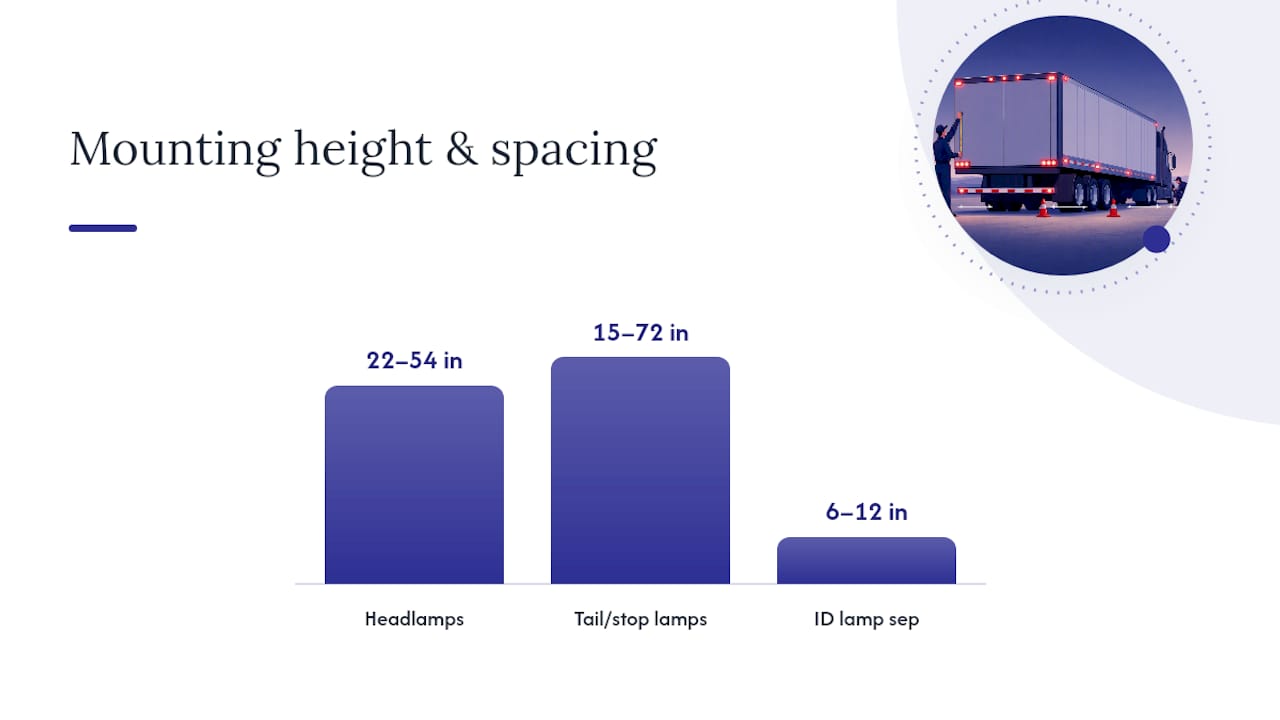
- Headlamps: generally mounted between 22 and 54 inches from the road surface.
- Tail lamps and stop lamps: generally mounted between 15 and 72 inches, measured center of the lamp to the road.
- Clearance and identification lamps: mounted as close to the top of the vehicle as practicable, since their job is marking overall height and width.
- Side marker lamps: positioned to indicate the length of the vehicle, spaced according to the vehicle’s own dimensions.
Measure from the center of the lamp lens to the road surface with the vehicle at its curb weight, not loaded or partially loaded. That distinction trips up a surprising number of shops doing DIY installs, because a trailer sitting on jack stands during install measures differently than one sitting on its tires at rest.
Spacing rules follow a similar logic. Lamps that come in pairs must sit as far apart as practicable, and identification lamps specifically need 6 to 12 inches of separation from each other at the vertical centerline. These aren’t arbitrary numbers. They exist so other drivers can judge a vehicle’s width and profile at night from a reasonable distance.
Pro Tip: Keep a printed mounting height reference in your maintenance bay. Techs eyeballing “close enough” during a quick trailer repair are the number one reason fleets fail height checks they’d otherwise pass easily.
Color and Visibility Rules Under FMVSS No. 108
Color isn’t cosmetic in commercial lighting. It’s a coded signal system, and FMVSS No. 108 exists specifically to make sure that code means the same thing on every truck on the road. The standard’s stated purpose is reducing traffic accidents by ensuring adequate illumination and conspicuity so other drivers can correctly read a vehicle’s signals in any visibility condition.
The color assignments are strict, and one prohibition trips up more fleets than any other rule in this section: amber cannot be optically combined with a stop or tail lamp. Stop and tail functions must show red. If a lamp housing combines stop, turn, and tail functions into one unit (a common design on trailers), the stop and tail portions have to read red, even though the turn signal portion inside that same housing can legally be amber.
Manufacturers certify a lamp’s visibility one of two ways, and understanding the difference helps when evaluating replacement parts:
- Luminous intensity testing: measuring actual light output at specified test points and angles.
- Effective projected luminous lens area: measuring the lens surface area that produces light, used as an alternative compliance path in the standard’s photometry tables.
Either method can satisfy FMVSS No. 108, but a lamp has to meet one of them, not just look bright to the naked eye. This is why a lamp bought at a general auto parts counter, designed for passenger cars, often fails commercial photometry even if it physically bolts onto a truck.
The clearest signal that a lamp has been through this certification process is the DOT marking stamped or molded into the lens itself. FMVSS No. 108’s marking section requires original and replacement headlamp lenses to carry “DOT” as certification under federal law. An unmarked lens is a red flag for an inspector, and it should be one for a buyer too. If the part you’re about to install doesn’t have that marking somewhere on the lens, it wasn’t built to meet this standard, no matter what the packaging claims.
Trailer Conspicuity: When Retroreflective Sheeting Is Required
Wide trailers need to announce their presence in the dark, and federal rules make that a mandatory design feature, not an optional safety upgrade. Under §393.11, trailers 80 inches or wider with a GVWR over 10,000 pounds, manufactured on or after December 1, 1993, must carry retroreflective sheeting or reflex reflectors meeting FMVSS No. 108, according to the FMCSA Motor Carrier Safety Planner.
A handful of trailer types are exempt from this requirement:
- Pole trailers, given their unusual length and load configuration.
- Trailers designed exclusively for carrying living quarters or offices, since they’re treated differently under the applicability rules.
- Trailers manufactured before the 1993 threshold date, though most fleets have long since cycled those units out.
Acceptable materials fall into two categories: retroreflective sheeting applied in strips along the trailer’s sides and rear, or reflex reflectors mounted at specified points, or a combination of both depending on the trailer’s design and how the manufacturer originally certified it. The installation location matters as much as the material choice. Sheeting placed too high, too low, or with gaps that break up the pattern doesn’t give oncoming or crossing traffic the visual cue the rule is designed to create.
If you’re running trailers old enough to predate factory conspicuity treatment, retrofitting is worth the investment even where it isn’t strictly mandated. Nighttime and highway visibility is the entire point of this rule, and a trailer that reads as a solid dark shape on a rural highway at 2 a.m. is a collision waiting to happen. Follow the same installation location references FMVSS No. 108 specifies for factory-applied sheeting so the retrofit actually delivers the coverage the standard intends.

Power, Activation, and Which Lamp Combinations Are Illegal
Required lamps have to run off the vehicle’s own electrical system. That’s the default rule, and the only carve out is for specific temporary lamps used to mark projecting loads, which may run on battery power in limited circumstances. A trailer with tail lamps wired to a battery pack instead of the tow vehicle’s harness is not meeting the standard, even if the lamps themselves are otherwise compliant.
Inspectors test activation behavior directly, and this is where a lot of otherwise-compliant setups fail in practice:
- Stop lamps must illuminate the instant the brake is applied, with no delay and no partial function.
- Turn signals must flash on the correct side and at a rate that’s clearly distinguishable from a steady-burning lamp.
- Hazard flashers must activate all turn signal lamps simultaneously, independent of the ignition or turn signal switch position.
Optical combination rules deserve their own callout because violations here are common and easy to miss during a quick visual check. Clearance lamps cannot be combined with tail lamps in a way that obscures either function. Amber cannot be combined with the stop or tail portion of a rear lamp cluster, a rule already covered in the color section above but worth repeating here because it’s specifically an activation and combination issue: the amber turn segment has to operate independently of the red stop and tail segments, both electrically and optically. A cluster where illuminating the turn signal also lights up part of the red lens as amber is a violation, even if each function works correctly on its own.
Common Inspection Failures and a Practical Maintenance Checklist
Lighting defects are one of the most frequent triggers for roadside gateway violations, according to FMCSA’s Motor Carrier Safety Planner, and most of them are preventable with a five-minute pre-trip routine.
- Walk the full perimeter of the vehicle and trailer with all lamps activated, including hazards, brakes, and reverse.
- Check every function individually rather than assuming a working headlamp means the whole circuit is fine.
- Inspect lenses for cracks, fogging, or fading that could dim output below photometric thresholds.
- Verify DOT markings are still visible and haven’t worn off or been painted over.
- Test mount integrity by gently pressing on each lamp housing to check for looseness or play.
- Inspect wiring and grommets at connection points for cracking, corrosion, or water intrusion.
- Check conspicuity tape and reflectors for peeling, cracking, or dirt buildup that reduces reflectivity.
The most common failure causes aren’t exotic. They’re temporary fixes that never got replaced with a permanent repair, cracked lenses that let moisture into the housing, wrong-color bulbs swapped in during an emergency roadside repair, missing DOT markings on aftermarket parts bought without checking, water intrusion through failed grommets, and mounting brackets that loosened over thousands of miles of vibration. A reefer pre-trip inspection checklist built for temperature-controlled trailers covers many of these same lighting checkpoints alongside the refrigeration-specific items, and it’s a useful template even for dry van fleets.
Seasonal checks matter too. Cold weather makes brittle plastic housings crack more easily, and road salt accelerates corrosion at wiring connections. After any repair involving the rear of the vehicle, a quick lighting recheck should be standard procedure, not an afterthought.
Pro Tip: Log every lighting repair with a date, part number, and technician initials. When a DOT officer sees a documented maintenance history, it signals a proactive fleet rather than one that’s cutting corners, and it can shorten the conversation considerably.
How to Choose DOT-Compliant Replacement Lamps
Replacement lighting isn’t the place to save a few dollars on an unmarked part, because a lamp that fails inspection costs far more in downtime than it ever saved at checkout.
Look for these specific markers before buying:
- A visible DOT marking molded or stamped into the lens, confirming certification under federal law.
- SAE reference codes printed on the lens, indicating which specific function and test standard the lamp was built to meet.
- Explicit FMVSS No. 108 compliance language in the product listing, not just generic “DOT approved” marketing copy.
- An IP rating (IP67 or higher for most trailer applications) confirming the housing resists water and dust intrusion.
- Solid mounting hardware, ideally metal brackets rather than thin plastic that cracks under vibration.
Inspectors treat unmarked aftermarket lamps with suspicion for good reason. Without the DOT marking, there’s no way to confirm the part went through the photometry and durability testing the standard requires, and that uncertainty tends to result in a citation rather than the benefit of the doubt.
Some suppliers carry product lines built around these exact checkpoints. The 16 LED jeep-style universal tail and brake light handles combined tail, stop, and turn functions in one stud-mounted housing. The 15 LED stud-mounted trailer towing light set covers a full trailer’s rear lighting array, including the license plate lamp, in a single kit. The 2 inch round clearance and marker light addresses the side marker and clearance requirements covered earlier in this article, with a flush-mount design that resists the loosening problems that plague bolt-on alternatives.
Quick DOT Lighting Compliance Checklist
Print this and keep it in the cab folder or the maintenance bay wall. It won’t replace reading the full regulation, but it catches the majority of what inspectors actually flag on the road.
If a lamp on your rig gets cited during a roadside stop, document the violation with photos, repair it before the next dispatch, and route anything ambiguous through your compliance officer or a review of the FMCSA guidance rather than guessing at the fix.
Why Compliance-Grade Lighting Is Worth the Investment
Certain suppliers build their lighting catalogs around standards like those covered in this article, because a lamp that looks right but fails FMVSS No. 108 photometry does a fleet no favors. The specialization here is durable, DOT-compliant lighting designed for trucks and trailers running in genuinely harsh conditions, not showroom parking lots.
That focus shows up in the construction details fleet managers care about most: leak-proof housings that resist the water intrusion problems covered earlier, and high-intensity reflectors built to exceed the federal photometry minimums rather than just scrape past them. Over a million drivers currently rely on components from All Star Truck Parts to stay visible and compliant on long hauls.
Take the checklist above and walk it against your current inventory. Where a lamp is unmarked, cracked, or running the wrong color, that’s your next order, not your next roadside citation.
— All
Order Compliant Replacement Lighting Before Your Next DOT Inspection
Fixing a cited lamp on the shoulder of a highway costs far more than fixing it in your bay the week before. Some suppliers stock replacement categories that cover these compliance areas, with DOT markings and FMVSS No. 108 citations indicated on product listings to help buyers verify compliance.
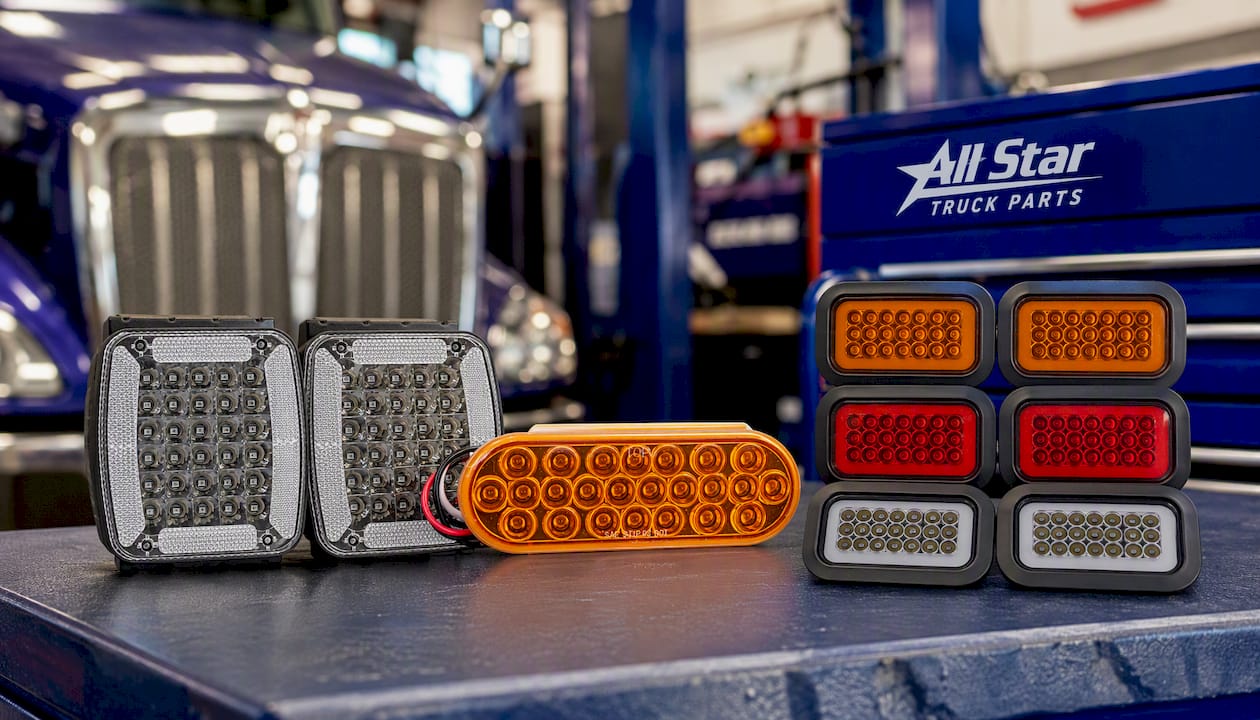
Three product lines solve the failures fleet managers report most often. The amber strobe light kit handles warning and safety visibility for towing and construction work, built DOT and SAE approved with an IP67-rated housing. The oval turn, tail, and clearance signal light replaces a common failure point on trucks and trailers in one combined unit. The 42 LED trailer tail light kit covers stop, turn, tail, and park functions marked to FMVSS 108 for trailers up to 80 inches wide.
Browse the full lighting, wiring, and reflective catalog and order the replacement parts your pre-trip checklist just flagged.
Where to Read the Actual Regulations
Product listings and articles like this one are a starting point, not the final word. The primary sources below carry the actual legal text and get updated when rules change.
- 49 CFR Part 393 Subpart B on the eCFR, covering required lamps, reflectors, and mounting.
- FMVSS No. 108 (49 CFR §571.108) on govinfo, covering photometry, marking, and visibility standards.
- The FMCSA Motor Carrier Safety Planner lighting section, covering inspection expectations and common violations.
Check these pages periodically. Federal lighting guidelines don’t change often, but when they do, it happens at the source first.
Sources
- eCFR :: 49 CFR 393.11 – Lamps and reflective devices.
- § 571.108 Standard No. 108; Lamps, reflective devices, and associated equipment. (govinfo)
- 5.1.8 Lighting Devices and Reflectors (393 Subpart B) - FMCSA Motor Carrier Safety Planner
- DOT § 571.108 — FMVSS No. 108 summary (Legal Information Institute / Cornell)
FAQ
What Are the DOT Lighting Requirements for Trucks?
Trucks must carry the lamp functions, quantities, colors, and mounting positions specified in 49 CFR §393.11 and FMVSS No. 108, including headlamps, tail lamps, stop lamps, turn signals, and clearance or marker lamps depending on vehicle width. Trailers 80 inches or wider add conspicuity sheeting or reflex reflectors to that list.
How Many Marker Lights Are Required by DOT?
The count depends on the vehicle’s length and width rather than a single fixed number, since side marker lamps are spaced to indicate the vehicle’s full profile. Clearance lamps are generally required in pairs, front and rear, on vehicles or loads 80 inches or wider, per §393.11.
How Many Brake Lights Do You Legally Need?
Commercial vehicles need a minimum of two stop lamps, mounted at the rear, showing red, and wired to activate instantly with the brake system. Combination stop, turn, and tail housings satisfy this as long as the stop function itself reads red and activates correctly under braking.
What Are OSHA’s Lighting Requirements for a Workplace or Maintenance Bay?
OSHA workplace lighting standards fall outside the DOT vehicle lighting rules covered here and apply to general facility illumination rather than truck or trailer equipment. For maintenance bays inspecting or repairing vehicle lighting, the relevant compliance standard for the equipment itself remains FMVSS No. 108, not OSHA’s facility lighting codes.
Why Do Aftermarket Lamps Need a DOT Marking?
The DOT marking on a lens certifies that the lamp passed the photometry and durability testing required under FMVSS No. 108. Inspectors treat unmarked replacement lamps as unverified equipment, which frequently results in a citation even when the lamp otherwise appears to work correctly.
